 |
|
|||||||||||||||||||||||||||||||
Tablet PCs: Motion Computing M1200Newcomer offers sleek, ergonomically designed slate with large display
A brief summary would describe the M1200 as a sleek and elegant pen slate targeted for duty in a variety of vertical markets that require a handy, lightweight computing device delivering the full power of Windows XP and all the functionality expected of a modern notebook computer. Like Fujitsu's line of Stylistic pen tablets, the MI 1200 is a durable device built around a magnesium alloy chassis, but it was not designed for use in overly harsh environments.
What sets the M1200 apart is its large 12.1-inch display. The Toshiba Portege also has a 12.1-inch screen, but the Motion is the only slate available at the November 7, 2002 Tablet PC launch with the larger LCD. All other tablets and convertibles use the smaller 10.4-inch format. Depending on your application, the larger screen gives the M1200 a definite competitive advantage.
The first impression you get when you pick up the M1200 is how elegant and "high tech" it looks and feels. What immediately comes to mind of long-time followers of the pen computing industry's, "This is what the pioneers had in mind when they designed the first pen computers over a decade a go." The M1200, of course, is thinner, lighter, and vastly more powerful than those early efforts. It's like comparing an early propeller airplane with the starship Enterprise. Both fly, but that is where the similarity ends.
Unlike some of the earlier slates, the Motion is anything but Spartan when it comes to built-in peripherals and connectors. A combination of Microsoft requirements and Motion philosophy resulted in a very well-connected machine. Along the bottom edge you'll find a phone jack for the internal V.92 PCTel 56k softmodem, a RJ-45 jack for a 10/100 LAN connection, video out, an expansion connector, two USB ports, an IEEE-1394 Firewire port, and both a microphone and a headphone jack. Along the right side there is the power jack, the power switch, and a PC Card Type II slot. All of those ports are openly accessible and not sealed, underlining the M1200's design for convenience rather than use in harsh environments. On the left there are two openings for tiny stereo speakers. Inside, you'll find a 802.11b wireless LAN mini PCI adapter.
Under the hood of the M1200 you'll find an 866 MHz Mobile Pentium III processor. Like almost any modern CPU, this PIII provides more than adequate punch, but as stated, despite a cooling vent on top, it also results in very substantial heat buildup. Providing power is a 11.1 Volt, 3.6Ah Lithium-Ion battery that is recessed flush into the bottom of the slate. Battery charging time is between 1-1/2 and two hours, and battery life should be in the four hour range. Going into standby mode took between three and eight seconds, coming out of it about five seconds. The M1200, without any applications running, also only took 10 seconds to go into hibernation and only 16 seconds to come out of it. The M1200 comes with 128 to 512MB of base RAM and has one PC133 expansion module for a maximum total of 1GB. Internal 2.5 inch hard disk drives are available with capacities of 20, 40, and 60GB.
In summary, Motion Computing has created a very competent pure slate computer (and formidable competitor to Fujitsu's Stylistic ST4000 tablet) that should have appeal to a variety of customers. Most will be "institutional" customers (utilities, insurance, government, healthcare, real estate, engineering, legal, etc.) but the company also hopes to attract executives, students, and assorted ahead-of-the-curve enthusiasts. Concerns include, as with most of this initial generation of Tablet PCs, heat build-up and unclear labeling of buttons. However, the large 12.1-inch display is definitely a plus, as is the overall design and execution of the unit. -
Motion Computing - www.motioncomputing.com
-
|
||||||||||||||||||||||||||||||||
|
[Homepage] All contents ©1995-2002 Pen Computing Magazine, Inc. All rights reserved. |
 Motion Computing, based in Austin, Texas, was formed by two former Dell executives specifically to create a Tablet PC. The company's first product is the Motion M1200, a "pure" tablet or slate design that is the direct successor of some of the pioneering pen slates of the early 1990s, such as the Samsung PenMaster or the original IBM ThinkPad. Unlike those early efforts, of course, the Motion slate is a thoroughly modern product that takes advantage of every ounce of the incredible advance in technology that has occurred over the past decade.
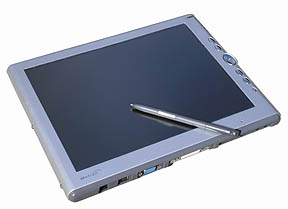 From a design point of view, the M1200 looks modern without being futuristic. The matte silver housing and slate "Nimbus" gray plastic top and bottom are pretty much industry standard. All edges are rounded, making it easy to hold the M1200. Like all Tablet PC slates, the Motion is designed to be used both in portrait and in landscape mode. In landscape mode, its six-button arrangement is on the right side and everything is within easy reach of your right thumb. In portrait mode, the button arrangement reminds of that found on Pocket PCs. Again a very workable solution.


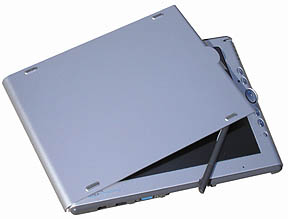 Like most pure slates, the Motion computer comes with a separate keyboard and a display stand, and an expansion "flexdock" is available as an option. They were not ready in time for us to preview. Motion says that it will ship the M1200 with an external optical drive.