Pen
Windows/WebPads/Tablet PCs
by Conrad H. Blickenstorfer
In this section we will give you a running update and overview, a chronicle really, on pen
computers that use the Windows 95/98/2000/NT/XP/XP Tablet Edition operating systems.
If you're interested in pen computing history, for a partial table of pen computers reviewed
in Pen Computing Magazine since our start in 1993, click here. The table also
provides access to some of the reviews published in Pen Computing Magazine.
If you're interested in more recent pen computing products, check our Tablet PC section.
Who uses pen computers?
Traditionally, pen
computers running Windows have been used primarily in vertical markets such as
utilities, insurance, health care, transportation, government, and sales force
automation. Unbeknownst to the general public, dozens of different pen
computers have been available over the past 15 years or so from companies such as
Symbol Technologies,
Fujitsu PC,
Fujitsu-ICL,
MicroSlate,
WalkAbout,
Xplore,
Panasonic,
Intermec (see review list),
Itronix and others. Pen computers come as
tablets, clamshells, and slates in many different sizes, configurations, and
degrees of ruggedness.
With the advent of Microsoft's Tablet PC specification and a special version
of Windows called "Windows XP Tablet PC Edition" at the end of 2002, "pen computers," systems
that use a stylus for navigation and use digital ink and recognition in addition to standard Windows
functionality, became increasingly attractive to corporate and even consumer markets
and several other companies began offering pen-enabled slates and notebooks.
Among them are Acer, Averatec, Motion Computing,
Toshiba and several others.
A brief history of pen computing
 A bit of history: Windows for Pen Computing
became the de-facto standard for most vertical market pen computers in the early 1990s after GO
Corporation's pen-centric PenPoint pen operating system, PenPoint, failed to
establish itself. PenPoint had had the early lead because Microsoft initially had no interest in pen computers, and only became involved when PenPoint began to receive a lot of attention. A bit of history: Windows for Pen Computing
became the de-facto standard for most vertical market pen computers in the early 1990s after GO
Corporation's pen-centric PenPoint pen operating system, PenPoint, failed to
establish itself. PenPoint had had the early lead because Microsoft initially had no interest in pen computers, and only became involved when PenPoint began to receive a lot of attention.
Between 1989 and 1992, pen computers were seen as having a bright future. Some predicted they may
challenge conventional keyboard-based computers and there was an inordinate amount of media hype.
However, inadequate hardware and unrealistic expectations caused early pen slates to flop. As a result,
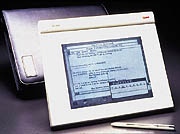
vendors either failed (EO, GRiD, etc.), withdrew pen products from the market (NCR (model 3115 shown in picture), Samsung, NEC, Compaq, IBM),
or concentrated on vertical markets (Fujitsu, TelePad, NEC). Note that the
original IBM ThinkPad was just that, a pen computer slate. In fact, it was developed to run PenPoint, and even in later models such as thee ThinkPad 730T the documentation still referred to PenPoint as the primary operating system. It was only later
that all IBM notebooks were also called ThinkPad.
After 1993, the very term "pen computing" became almost a dirty word. Everyone mocked and abandoned the concept and handwriting recognition, in particular, came to be viewed as a failed technology. Unfortunately for Apple, the Newton messagePad arrived at just that time, in the Fall of 1993. The spin at the time was that while pen computing apparently wasn't for notebooks, it would become a huge success in PDAs, Personal Digital Assistants. The original Newton was a brilliant product, albeit one with some rather serious flaws. While it included numerous innovations, it heavily relied on handwriting recognition which, at lest in its first iteration, didn't work very well. Industry pundits and even cartoonists mercilessly pounded the Newton as a result. For a full history of the Newton, read our Newton Notes archive and the story of its eventual demise.
When Windows 95 came out in the Fall of 1995, a much improved version 2.0 of the pen
services was late and proved difficult to work with. Also, Microsoft didn't deliver as much as it had promised, leaving many pen computing developers frustrated. As a result, some vendors of
pen computers turned to Communication Intelligence
Corporation's PenX alternative, or provided only rudimentary pen
functionality in the form of a digitizer control panel.
The primary reason why Windows was
being used in mobile pen system despite the absence of many mobile features is the seamless integration into a company's
corporate IT structure. There is no need for retraining of users or programmers.
However, at the turn of the millennium, the future of mobile pen computing clearly seemed to be in smaller, more mobile
operating environments such as Windows CE, the Palm OS, or EPOC/Symbian.
Another interesting development starting around 1999 was an emerging generation of
"Webpads," which were essentially pen tablets with wireline/wireless internet connections.
Almost all those Webpads were derivatives of the groundbreaking Zenith
CruisePad (circa 1995) that met an untimely death when Zenith Data Systems was sold to
Packard Bell (sigh!). National Semi was the primary
champion of the Webpad effort for two or three years, but that changed when
Microsoft was getting back into the picture with the Tablet PC. Webpads, as originally conceived, may continue in some form as thin clients,
and also as Windows CE.Net/Mobile powered devices. Smart Displays, initially
codenamed "Project Mira," were another short-lived Microsoft tablet
initiative. The idea was to create lightweight tablets that would wirelessly
communicate with a Windows XP host. The project seemed ill-conceived and
quickly folded. See Pen Computing Magazine's features on those "smart
displays," MIRA -- Microsoft's Home Tablet Initiative Redefines the
Webpad and Microsoft Smart Display - an Update to the Project Formerly
Known as MIRA.
Microsoft invents pen computing -- again
Bill Gates' keynote at the Fall 2000 Comdex was somewhat amusing to pen historians as Gates held up
a webpad, called it "Tablet PC," and acted as if this were some great new technology that
Microsoft had just invented. At the WinHEC 2001 conference in early 2001, Microsoft
revealed more details of its Tablet PC effort, including a number of
hardware and software partners. That conference was followed by an invitation-only NDA conference where Microsoft
revealed more technical details to an audience of mostly OEMs and developers.
Pen Computing Magazine published a comprehensive first look at the Tablet PC project in the July 2001 issue. In it,
Pen Computing contributing writer Geoff Walker analyzed and commented on every aspect of the project and the technology. At the time, interest in the proposed Tablet PC platform was
heating up as shipment of traditional PCs and even notebooks was slowing down or leveling off. There were informal projections that of 45 million notebooks shipped in 2005, and a full half of those were expected to use the Tablet PC extensions. We figured that even if only one in five of those devices were an actual tablet or slate, that would be almost five million pen slates a year. Those projections turned out to be overly optimistic.
Ever since, Pen Computing has been covering the Tablet PC project very closely, running regular updates.
We published features like How to Select a Tablet PC, What Can You Do With a Tablet PC?, primarily a look at
enabling software, Running Linux on a Tablet PC? where we looked at X
Servers on tablets, How to Select a Second Generation Tablet PC, and more.
At some point we even a special 32-page insert dedicated entirely to the Tablet PC. We had hoped it would eventually evolve into a separate Tablet PC Magazine and even approachd Microsoft for sponsorship. No dice. So we continued to cover Tablet PCs in Pen Computing.
Those who expected the Tablet PC to be a truly revolutionary product, like the PenPoint machines were back in the early 1990s, are probably disappointed with the current Tablet PC. The platform has essentially split into Tablet PC slates made primarily by Fujitsu, Motion Computing and a few others, and Tablet PC notebook convertibles made by Acer, Fujitsu, Hewlett Packard, Toshiba, Averatec and others. The slates are primarily used in vertical markets, whereas the convertibles have been making modest inroads into consumer and business markets. The once vast price difference between standard and pen-enabled machines has come way down. HP even sells their notebook convertible at no price premium at all.
While Pen Computing Magazine follows these new trends closely, count
on us to continue to provide intensive coverage of both Windows-based pen computers
and their enabling technologies, such as handwriting and voice recognition, wireless
components, scanning attachments, and other mobile peripherals, as well as all other mobile platforms.
2006 brings the "Ultra-Mobile PC"
During 2005 and even earlier, Microsoft had been hinting at tablets smaller
and simpler than even the smallest Tablet PC slates. Such tablets were
supposed to cost little, 500-700 dollars perhaps, and represent a "back to
basics" move -- computing for everyone, everywhere.
In early 2006, a cleverly managed rumor campaign, led by a Flash site
hinting at a mysterious little device called "Origami," was culminated by
the release of the "Ultra-Mobile PC," or UMPC, at the CeBIT show in Hanover, Germany.
The UMPC turned out to be a small tablet with a 7-inch screen, running the
full XP Tablet PC Edition, but using a passive digitizer. To make that work,
a set of special touch utilities are included. Not much hardware was shown,
and none was initially available. See our intro to Origami
and our much more detailed analysis of the
Microsoft UMPC platform.
2007: Vista, UMPCs, and MIDs
When Microsoft Windows Vista arrived in early 2007, Microsoft decided to include all pen functionality rather than offering a separate version as it had done with the Windows XP Tablet PC Edition. We've reviewed several slates with Vista and Microsoft did a good job seamlessly integrating all the pen options.
In the meantime, Microsoft had also introduced the Ultra-Mobile PC, or UMPC, platform in March of 2006. Microsoft's described the UMPC as "a device-like computer that is small, mobile, and runs the full Windows operating system. The UMPC goes anywhere and does anything that your current computer can do." The UMPC was initially conceived as a small, inexpensive slate with a touchscreen, but the concept didn't catch on due to low performance and higher than expected pricing.
In May of 2007, Microsoft loosened the design description to "any portable computer running full Windows with a screen size of 7 inches or smaller." Intel announced its own Intel Ultra Mobile Platform 2007 based on low-power Intel A100 and A110 processor designed to drive both UMPCs and yet another category, Mobile Internet Devices or MIDs. MIDs do not necessarily have to run standard Windows. Both the UMPC and the MID platforms are naturals for handheld rugged devices and we'll undoubtedly see many interesting designs.
2008: The return of touch
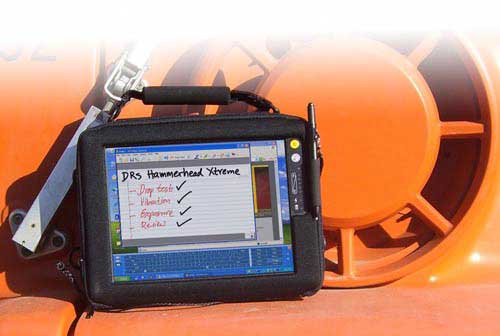
With the hugely successful iPhone, Apple once again changed everything. The iPhone's sleek and intuitive capacitive multi-touch interface redefined touch screens and what they can do, and all of a sudden everyone else is trying to follow suit. We're seeing touch screens in regular consumer notebooks again, and even in desktop machines. In rugged machines we're more and more seeing "dual touch" systems that can use both touch and an electromagnetic pen. The Tablet PC never really caught on, in part due to technological issues and in part due to Microsoft's inconsistent attention to the platform.
2009/2010: Tablet hype
Multi-touch continues to gather momentum, with many manufacturers offering some sort of multi-touch capabilities in notebooks, tablets and even desktops. The newly released Windows 7 has integrated touch and multi-touch capabilities. Implementation is often clumsy, which shows the difficulty of scaling up the super-smooth operation of the Apple iPhone. Rumors abound of a new Apple slate device all year, and come to a fever pitch at the 2010 CES in Las Vegas where numerous tablets and tablet concepts are shown. Microsoft had been expected to make some sort of tablet announcement, but, apart from CEO Steve Ballmer briefly showing an HP concept, nothing happens.
A few days later, however, Apple announced the iPad, a sleek 1.5-pound slate intended to fit between an iPhone and a regular notebook computer. The device is clearly built from the iPhone up, and not from a notebook down, and so will primarily address the needs of those who have begun using their smartphones as notebook replacements but would like a larger screen. Microsoft, in the meantime, closes its Tablet PC blog and, for all practical purposes, their Tablet PC experiment is over.
The iPad's introduction is met with downright scorn by many tech and mainstream journalists, but Apple proves them wrong as the iPad becomes a megahit, with some ten million sold in 2010, and projections for much more ahead. Everyone scrambles to get a piece of the tablet action, tablets are seen as threatening netbook sales, and the Android OS looms large as the prospective major competitor for Apple. Microsoft seems undecided on whether to develop its own true web-optimized OS, simply use Windows 7, or perhaps offer a scaled up version of its Windows Phone 7 mini-OS. Hewlett Packard, which had bought Palm, contemplates launching tablets with Palm's WebOS.
2011: Begin of the post-PC era?
With some 15 million Apple iPads sold in 2010, it is clear that the touch tablet platform has massive potential. Analysts predict huge media tablet sales, in part replacing netbooks, in part even standard notebooks.  Despite the success of the Android OS in smartphones (where it became the leader in 2010), tablet competition to the iPad is slow in ramping up. Samsung launched their 7-inch Tab late 2010, RIM and HP announced tablets, but Motorola got the best press with their 10.1-inch Xoom Android tablet. The biggest problem seems that there is not much opportunity for vendors to a) differentiate themselves, and b) meet Apple's very low pricing. Despite the success of the Android OS in smartphones (where it became the leader in 2010), tablet competition to the iPad is slow in ramping up. Samsung launched their 7-inch Tab late 2010, RIM and HP announced tablets, but Motorola got the best press with their 10.1-inch Xoom Android tablet. The biggest problem seems that there is not much opportunity for vendors to a) differentiate themselves, and b) meet Apple's very low pricing.
By early 2011, Microsoft had still not reacted to the tablet boom, still referring to Windows 7. Motion Computing released the CL900, the first somewhat ruggedized media tablet, and Fujitsu followed with the similar Stylistic Q550. Panasonic pre-announced a 10.1-inch Android tablet. In September, Microsoft showed a developer demo of Windows 8 with a touch-oriented "Metro" front end and support for ARM processors, albeit not in "classic" Windows 7 mode. In October, Motorola Solutions, now separate from the Motorola "Mobility" phone business (acquired by Google in the summer of 2011), introduced a ruggedized 7-inch Android tablet, the ET1. And in November, Panasonic announced the Android-based Toughpad line of tablets.
2012: iPad continued to blaze the tablet trail
In early 2012, Apple introduced the 3rd generation iPad that set a new display resolution standard for tablets with a 2028 x 1536 pixel LCD. With tens of millions of media tablets sold, the iPad and its still struggling competition have clearly blazed the trail for the tablet form factor. The question in mid-2012 was whether it would be Android or Windows 8-based tablets that provide the primary iPad competition, and whether rugged vertical market tablets will be able to benefit from the iPad's popularity. In the Fall of 2012, Microsoft formally introduced Windows 8 and with it the Windows RT version of its Surface tablet. The Surface hardware was well accepted, the Windows RT software, written to run on ARM processors but curiously stunted, less so. For the most part, tablet makers held off on Windows 8, assuming a wait-and-see attitude.
This article was also translated to Serbo-Croatian by Jovana Milutinovich for Geeks Education.
Portuguese translation of this page by Artur Weber at https://www.homeyou.com/~edu/pen-windows..
|